- (513) 305-0700

For decades, laboratory owners and engineers operated under a simple assumption: more air changes per hour (ACH) meant a safer laboratory. Today, guidance from organizations such as ASHRAE, AIHA, and the International Institute for Sustainable Laboratories (I2SL) suggests a different approach.
While ventilation remains critical for laboratory safety, higher ACH alone does not guarantee better protection. In fact, excessive ventilation can significantly increase energy costs without delivering meaningful improvements in containment or occupant safety.
The question laboratory owners should be asking isn’t, “How much air are we moving?” but rather, “Are we delivering the airflow needed to safely support the work being performed?”
Laboratories are among the most energy-intensive building types in operation. According to research supported by the National Renewable Energy Laboratory (NREL), HVAC systems can account for approximately 45% to 85% of total laboratory energy consumption, with ventilation often representing the largest single energy load.
As universities, healthcare organizations, and research facilities pursue sustainability initiatives and seek to reduce operating expenses, ventilation strategies are receiving renewed attention.
Many facility leaders are discovering that they may be conditioning more air than their laboratories require. For facilities evaluating opportunities to optimize laboratory airflow performance, AEB Technologies provides expertise in laboratory airflow control, room pressurization, and critical environment monitoring.
Air changes per hour measure how often the air within a room is replaced. While ACH is an important design parameter, it does not directly measure a laboratory’s ability to contain hazards. According to AIHA guidance, laboratory ventilation should be based on hazard assessment and contaminant control rather than relying solely on a prescribed air change rate.
Consider two laboratories:
Most would agree that Laboratory B provides superior protection despite operating at a lower ventilation rate. The reason is simple: laboratory safety depends on effective containment and airflow control, not airflow volume alone.
One of the most significant developments in laboratory design is ASHRAE’s Laboratory Ventilation Design Level (LVDL) framework. Rather than applying a universal ACH requirement, the framework encourages engineers to align ventilation strategies with the actual hazards present within the laboratory.
This risk-based approach helps balance three critical objectives:
Instead of over-ventilating every space, laboratories can tailor airflow requirements to support specific activities while reducing unnecessary energy consumption.
As ventilation strategies become more performance-based, accurate airflow measurement and control become increasingly important.
Facility teams need confidence that:
Technologies such as airflow control valves, room pressure monitoring systems, and advanced fume hood controls help laboratories achieve these goals.
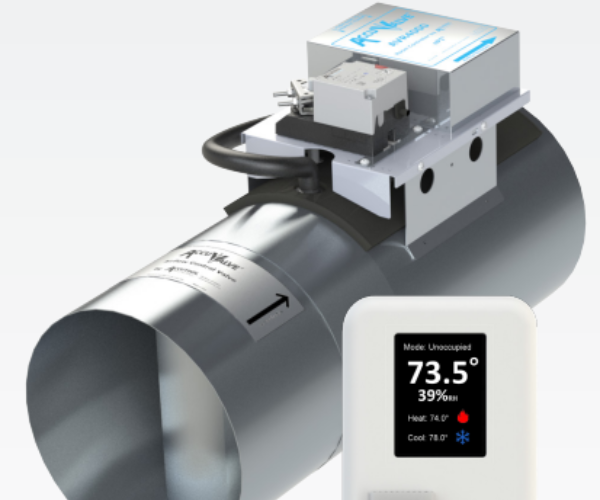
For example, Accutrol’s AccuValve® Airflow Control Valve provides direct airflow measurement and fast-response control, while the AVC Fume Hood Control System helps maintain containment performance under changing operating conditions.
The objective is not to reduce airflow at the expense of safety. The objective is to accurately control airflow so laboratories can achieve both safety and efficiency.
Rather than focusing solely on ACH, consider the following questions:
The answers often reveal opportunities to improve performance while reducing operating costs.
The future of laboratory ventilation is not about maximizing airflow. It is about delivering the right airflow, in the right place, at the right time. As laboratory owners seek safer, more sustainable, and more cost-effective facilities, airflow accuracy, containment performance, and risk-based ventilation strategies are becoming the new standard.
If you’re planning a laboratory renovation, designing a new research facility, or evaluating the performance of an existing ventilation system, AEB Technologies can help.
Contact our team for a complimentary 15-Minute discussion of your application, operational goals, and ventilation challenges.